
08.10.2026
Sometimes, in an old taweez, you come across something puzzling: rows of Arabic letters with not a single dot among them. To the uninitiated it looks like incomplete or mistaken writing. To the tradition, the absence of dots is entirely deliberate, and it carries a deep meaning.
To understand why some taweez written without dots exist, we have to join two threads together. The first is the history of the Arabic script itself, which in its earliest form had no dots at all. The second is the science of letters, ilm al-huruf, which treats the undotted, luminous letters as carriers of a special spiritual power. This article explains both, drawing exclusively on Arabic, Persian and Urdu sources, and shows why a taweez written without dots was a mark of mastery rather than error.
The first surprise for many readers is that the earliest Arabic script had no dots whatsoever. The undotted Arabic letters were the original form of the writing, and the dots we know today were a later addition. In the beginning, the letters were distinguished only by their shapes, and many shapes were shared between several letters.
The Arabic sources record that as the Islamic state expanded and non-Arab peoples entered Islam, a danger arose. Those unfamiliar with the language began to misread the Quran, confusing letters that shared a single shape, such as ba, ta and tha, or jim, ha and kha. The scholars feared that this confusion of undotted Arabic letters would creep into the recitation of the Book of Allah itself. In response, the scholar Nasr ibn Asim, acting on the instruction of al-Hajjaj, placed the dots upon the letters to distinguish the similar shapes from one another.
From this history comes a piece of technical vocabulary that matters for our subject. The Arabic tradition divides the letters into al-huruf al-mujama, the dotted letters, and al-huruf al-muhmala, the undotted or, literally, the neglected letters. The crucial point is this: a taweez written without dots is not using a broken or deficient script. It is using the older, original form of Arabic writing, the form in which the very first copies of the Quran were set down.
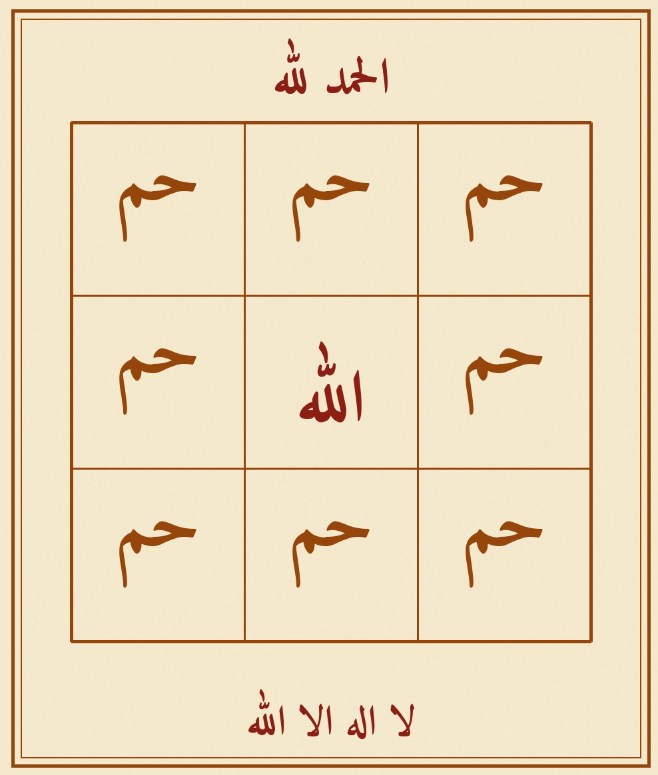
The category of al-huruf al-muhmala, the undotted letters, is the key to the whole practice. These are the letters that naturally come without dots: alif, dal, ra, sin, sad, ta, ayn, lam, mim, ha and waw. A scribe who deliberately composes a text using only these letters, or who strips the dots from a passage, is working within a recognised and demanding tradition.
That it was a genuine craft is shown by the science of Hadith. The Arabic sources on Hadith transmission record that the scholars developed careful ways to control, or dabt, the undotted letters, using small marks beneath the letter, a sign called the qalama, or safety dots, so that a reader would not be confused. Ibn al-Salah and Iyad both discussed how to mark the muhmala letters such as dal, ra and sad. The fact that scholars needed a whole method to handle undotted Arabic letters tells us that writing without dots was a living art requiring real skill.
In the taweez tradition, this skill takes on a further dimension. A writer who deliberately produces a text in the muhmala letters demonstrates a command of the script and creates a text with a distinct character. There is a long tradition that the taweez written without dots draws on the sense that the undotted forms are purer, closer to the original shape of the Revelation. As we explored in our article on why Persian scholars called taweez naqsh, the very form of a letter was held to be a carrier of meaning, so a taweez written without dots is a taweez written in the most essential form of the letters. This is why the science of letters ilm al-huruf paid such close attention to which letters carried dots and which did not.
The deepest reason for writing a taweez without dots lies in a special category of letters. In the spiritual tradition, the undotted letters are connected to the al-huruf al-nurania, which translates as the luminous letters. Understanding the luminous letters in Islam is the heart of the matter, and the huroof nurania meaning is where the historical thread and the spiritual thread finally meet.
The Arabic sources explain that the letters are divided into two groups: the nurania (luminous) and the zulmania (dark). There are fourteen luminous letters, exactly half the alphabet, and they are gathered in the memorable phrase nass hakim qati lahu sirr, meaning a wise text, decisive, that has a secret within it. The point that connects this to our subject is striking: these fourteen luminous letters are precisely the letters of the fawatih al-suwar, the disconnected letters that open twenty-nine surahs of the Quran, such as alif lam mim, kaf ha ya ayn sad, and ha mim ayn sin qaf.
The full huroof nurania meaning goes further still. By one interpretation recorded in the Arabic sources, each of these letters points to a name of Allah. The kaf in kaf ha ya ayn sad is taken from al-Kafi, the ha from al-Hadi, the ya from al-Hakim, the ayn from al-Alim, and the sad from al-Sadiq. Ibn Abbas is reported to have said of alif lam mim that the alif points to the name of Allah, the lam to the name of Jibril, and the mim to the name of Muhammad (peace be upon him). One tradition holds that if people could only arrange these letters correctly, they would discover al-ism al-azam, the Greatest Name of Allah. The luminous letters in Islam are thus seen as a concentrated form of sacred power, and because the disconnected letters Quran readers meet at the start of those surahs are written without dots in their luminous form, a taweez that carries them, or that is written entirely in undotted letters, is understood to carry that same concentrated power. This is the fullest huroof nurania meaning the tradition offers.
A point of balance: the division of letters into luminous and dark, and the claims made about them, do not have an authentic basis traced to the Prophet (peace be upon him) or the early generations. As Islamweb notes, the meaning of the disconnected letters Quran opens with is regarded by the majority of scholars as among the mutashabihat, the matters whose full knowledge rests with Allah, and one should be cautious about speaking of the Book of Allah without knowledge. This is presented here as the tradition records it, not as established doctrine.
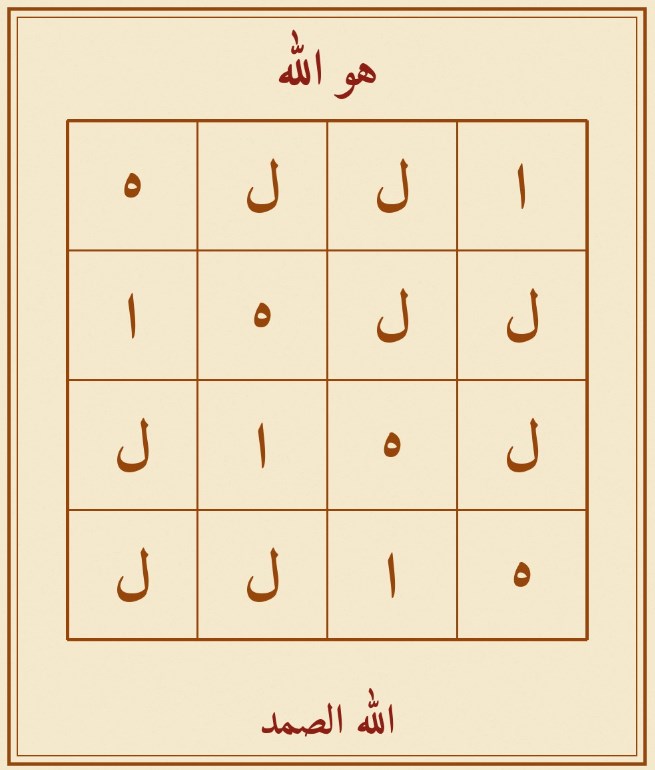
Within the science of letters ilm al-huruf, the undotted and luminous letters occupy a special place, and the secret of Arabic letters is the thread that runs through the whole discipline. As we explained in our articles on the spiritual meaning of the number 786 and the manuscript science of Central Asia, the letters carry numerical values through the abjad system and were held to carry spiritual properties.
The undotted letters were considered the barer, more fundamental forms, carriers of pure letter-power without the addition of the dot. This is the heart of the secret of Arabic letters as the tradition understood it: that the shape itself, undotted, was closest to the original act of Revelation. The mysterious letters taweez writers placed at the head of their work, the fourteen luminous letters, were treated as keys, and these are the same disconnected letters Quran readers meet at the opening of twenty-nine surahs. The same disconnected letters appear in our article on Hizb al-Bahr, where ha mim ayn sin qaf and kaf ha ya ayn sad were carried as protective formulas.
So when a writer composed a taweez using the muhmala letters, or placed the luminous mysterious letters taweez tradition prized at its head, he was applying the science of letters ilm al-huruf in its most refined form. The undotted text was not a shortcut or a mistake, but the application of a whole theory about where the power of the letters truly lies, and the secret of Arabic letters was understood to be most present in exactly these undotted, luminous forms.
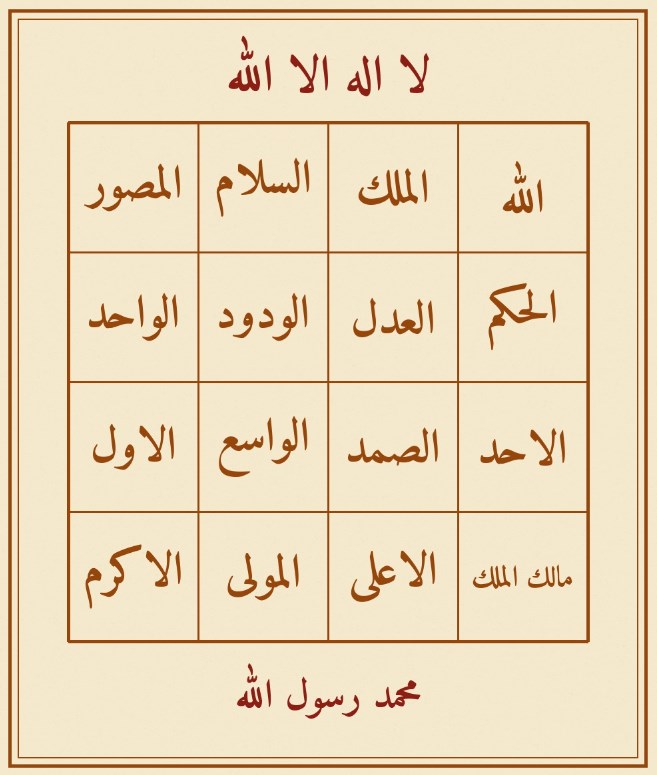
When you next see a taweez written without dots, or one that carries the disconnected letters of the Quran at its head, you will understand that you are looking at a deliberate tradition and a mark of mastery, not an error. The writer who produces a clean text in the undotted letters is demonstrating command of both the historical form of the script and the deep science of letters ilm al-huruf.
The balanced view is the one to hold onto: an authentic taweez rests on Quranic content and the names of Allah, written with the belief that Allah alone protects. The letter-science, with its luminous letters and undotted forms, is a tradition in the service of that content, never a substitute for it. The huroof nurania meaning, and the standing of the luminous letters in Islam, are part of the heritage of the craft, but they point toward the divine names rather than replacing them. Every taweez at taweez.co.uk is written by hand in this classical tradition. You can see it in our 99 Names of Allah taweez, built on the divine names that the luminous letters point toward; in our handwritten taweez for nazar; and in our gold taweez and taweez karma plate, where the letters are engraved into enduring metal.
Author: Salam Burdu
Salam Burdu is an Islamic scholar and lecturer from Pakistan who is known for his expertise in the field of Islamic spiritual healing and protection.